Summary: Compare Hailuo 2.3 and Kling v2.6 in 2026—quality, cost, text rendering, character consistency, and real-world tests based on independent blind testing across 8 challenging scenarios.
The AI video generation landscape has never been more competitive. With Hailuo 2.3 (by MiniMax) and Kling v2.6 (by Kuaishou) both claiming industry-leading performance in early 2026, creators and developers face a critical question: which model delivers the best results for real-world production workflows?
At Vidguru AI Lab, we conducted a rigorous, blind-test benchmark across 8 high-complexity scenarios designed to expose the weaknesses that matter most: fluid dynamics, anatomical accuracy, character consistency, text rendering, physics simulation, multi-subject interaction, cinematic motion, and dynamic transformations.
This isn't a marketing comparison. This is a production-grade stress test with identical prompts, identical input images, default parameters, and single-generation runs—no cherry-picking, no retries.
**TL;DR: The 60-Second Verdict**
Don't have time for the full 3,000-word breakdown? Here is the bottom line:
- The Winner: Hailuo 2.3 (MiniMax) narrowly edges out Kling v2.6 with a score of 23 vs. 22.
- Best for Text: Hailuo 2.3 is the undisputed king of text rendering (signage, UI, branding).
- Best for Realism: Kling v2.6 (Kuaishou) remains superior for facial identity and character consistency.
- Cost Factor: Hailuo 2.3 is 25% cheaper per generation ($0.28 vs $0.35).
- The Catch: Kling v2.6 has native audio; Hailuo 2.3 is currently silent.
**Quick Feature Comparison**
| Feature | Hailuo 2.3 (MiniMax) | Kling v2.6 (Kuaishou) |
|---|---|---|
| Max Resolution | 1080p | 1080p |
| Max Duration | 10s | 10s |
| Native Audio | No | Yes (High Quality) |
| Text Rendering | Excellent | Poor |
| Character Sync | Good | Elite |
| Cost (5s Video) | $0.28 | $0.35 |
Table of Contents
- Testing Methodology
- Model Specifications
- Cost Analysis
- Detailed Test Results
- Test 01: Complex Fluid Dynamics
- Test 02: Anatomy & Motion Accuracy
- Test 03: I2V Character Consistency
- Test 04: Text Rendering & Stability
- Test 05: Physics & Light Feedback
- Test 06: Multi-Subject Interaction
- Test 07: Cinematic Motion (FPV)
- Test 08: I2V Dynamic Transformation & Depth
- Final Verdict
- Scoring Summary
- FAQ
- Related Articles
- About Vidguru
Testing Methodology
To ensure fairness and eliminate bias, we followed a strict blind-test protocol:
Test Parameters
- Single-generation runs: No retries or cherry-picking
- Identical prompts: Same text descriptions for both models
- Identical input images: For image-to-video tests, both models received the same source image
- Default parameters: No manual tuning—all settings at system defaults
- Platform: All tests conducted on Vidguru
- Scenario selection: High-complexity, AI-prone failure cases (fluid physics, hand anatomy, rapid motion, text rendering)
Scoring System (1-5 Scale)
- 5 points: Production-ready quality, no visible artifacts, meets prompt requirements
- 4 points: Minor flaws but usable for most workflows
- 3 points: Noticeable issues but recognizable intent
- 2 points: Significant defects, limited usability
- 1 point: Major failures, unrealistic output
- 0 points: Complete failure to meet basic requirements
Audio Note
Hailuo 2.3 does not currently support audio generation. All test videos are silent. Kling v2.6 supports native audio synthesis, but we disabled it for fair comparison since audio was not the focus of this benchmark.
Model Specifications
Hailuo 2.3 (MiniMax)
Hailuo 2.3 is a high-fidelity video generation model optimized for realistic human motion, cinematic VFX, and strong prompt adherence. It supports both text-to-video and image-to-video workflows.
Key Specifications:
- Input modes: Text-to-video, Image-to-video
- Resolution: 768p and 1080p (1080p limited to 6 seconds)
- Duration: 6 seconds or 10 seconds
- Aspect ratio:
- Image-to-video: Follows source image
- Text-to-video: Defaults to 16:9
- Audio support: Not yet available
- Strengths: Realistic motion physics, facial detail, style stability
Try Hailuo 2.3 on Vidguru:
Kling v2.6 (Kuaishou)
Kling v2.6 is a top-tier video generation model with cinematic visuals, fluid motion, and native audio generation. It excels in photorealistic scenes and supports synchronized sound effects.
Key Specifications:
- Input modes: Text-to-video, Image-to-video
- Resolution: 1080p
- Duration: 5 seconds or 10 seconds
- Aspect ratio: 16:9 (horizontal), 9:16 (vertical), 1:1 (square)
- Audio support: Native audio generation (dialogue, ambient sound, effects)
- Strengths: Cinematic quality, audio-visual sync, character animation
Try Kling v2.6 on Vidguru:
Cost Analysis
For 5-second video generation (estimated via Vidguru API calls):
| Model | Cost per Video | Relative Cost |
|---|---|---|
| Hailuo 2.3 | $0.28 | Baseline |
| Kling v2.6 | $0.35 | +25% more expensive |
Winner: Hailuo 2.3 offers better cost efficiency, especially for high-volume production workflows.
Detailed Test Results
Test 01: Complex Fluid Dynamics
Prompt:
A glass of red wine falling onto a white marble floor, the moment of impact with liquid splashing in slow motion, realistic glass shards, sharp focus, 4k.
Challenge:
Fluid dynamics are notoriously difficult for AI video models. This test evaluates physics accuracy, material rendering (glass, liquid), and slow-motion realism.
| Hailuo 2.3 (T2V) | Kling v2.6 (T2V) |
|---|---|
Analysis:
Hailuo 2.3:
Complete failure. The glass does not shatter realistically. Instead, the splashing wine morphs into glass-like shards—a fundamental physics violation. The overall scene looks artificial and unconvincing.
Kling v2.6:
Also fails to deliver realistic physics. The wine glass appears to be made of a gel-like material rather than glass. The splash dynamics are unconvincing, and the impact lacks the sharp, chaotic energy of real-world fluid behavior.
Lab Expert Note: This test sets an extremely high bar for AI video models. Vidguru AI Labs has tested multiple models in this scenario, and most struggle to deliver realistic results. If you need to generate high-fidelity physics-based videos like this, we highly recommend using VEO 3.1—the only model that passed this test in our lab. Try VEO 3.1 on Vidguru →
Scores:
- Hailuo 2.3: 0/5 (Complete physics failure)
- Kling v2.6: 0/5 (Unrealistic material rendering)
Winner: Tie (both failed)
Test 02: Anatomy & Motion Accuracy
Prompt:
Close up of a magician's hands performing a card trick, shuffling cards rapidly, fingers moving with high precision, cinematic lighting.
Challenge:
Hand anatomy is one of the hardest challenges for generative AI. This test evaluates finger count, joint articulation, and motion fluidity.
| Hailuo 2.3 (T2V) | Kling v2.6 (T2V) |
|---|---|
Analysis:
Hailuo 2.3:
Fingers are anatomically correct, and the shuffling motion is accurate. However, the playing cards only show the back design—no face cards are visible. Additionally, the card shuffle has a slight artificial quality that betrays its AI origin.
Kling v2.6:
The video looks more photorealistic overall, with no obvious AI artifacts. However, the shuffling speed is far too slow, failing to meet the "rapidly" requirement in the prompt. The motion lacks the dynamic energy expected from a skilled magician.
Scores:
- Hailuo 2.3: 3/5 (Correct anatomy, but limited card detail and slight artificiality)
- Kling v2.6: 4/5 (Photorealistic, but motion too slow)
Winner: Kling v2.6
Test 03: I2V Character Consistency
Setup:
Upload a high-resolution portrait (AI-generated or real person).
Instruction:
The person in the photo is laughing uncontrollably, head tilting back, wrinkles appearing around eyes, natural skin texture.
Challenge:
Maintaining facial identity during extreme expression changes is a critical test for image-to-video models.
| Original Image | Hailuo 2.3 (I2V) | Kling v2.6 (I2V) |
|---|---|---|
 |
Analysis:
Hailuo 2.3:
During the laughter sequence, the person's face undergoes drastic changes. While the first few seconds maintain consistency, the final frames show noticeable drift from the original identity. It's difficult to believe this is the same person.
Kling v2.6:
Exceptional performance. The laughter is highly realistic, with natural skin texture, wrinkle formation, and head tilt. Most importantly, facial identity remains perfectly consistent throughout the entire sequence. No visible AI artifacts.
Scores:
- Hailuo 2.3: 2/5 (Identity drift in later frames)
- Kling v2.6: 5/5 (Perfect consistency, photorealistic)
Winner: Kling v2.6
Test 04: Text Rendering & Stability
Prompt:
A handheld camera panning across a futuristic street, a glowing neon sign clearly displaying "FUTURE IS NOW", rain falling, reflections on the pavement.
Challenge:
Text rendering is a known weakness for most AI video models. This test evaluates legibility, stability, and integration into the scene.
Test 04: Text Rendering (Neon Signs)
Prompt: "A cinematic FPV drone shot through a futuristic cyberpunk street at night, neon signs on buildings clearly saying 'FUTURE IS NOW', heavy rain, reflections on wet pavement."
| Hailuo 2.3 (T2V) | Kling v2.6 (T2V) |
|---|---|
Analysis:
Hailuo 2.3:
Surprising success. The neon sign clearly displays "FUTURE IS NOW" with accurate spelling and stable rendering throughout the camera pan. The text is legible and well-integrated into the futuristic street scene.
Kling v2.6:
Complete failure. The text is garbled and unreadable. While the overall scene quality is high (realistic rain, reflections, lighting), the text rendering is completely incorrect—a critical flaw for any workflow requiring on-screen text.
Lab Expert Note: Hailuo 2.3 seems to have a built-in OCR-aware decoder. Based on Vidguru AI Lab's testing, Veo 3.1 also excels at accurate text rendering, but at roughly double the cost. For budget-conscious workflows requiring text, Hailuo 2.3 offers the best cost-performance ratio.
Scores:
- Hailuo 2.3: 5/5 (Perfect text rendering)
- Kling v2.6: 1/5 (Text completely wrong, but scene quality is decent)
Winner: Hailuo 2.3
Test 05: Physics & Light Feedback
Prompt:
A person walking through a dark forest with a flaming torch, the orange light illuminating trees and casting moving shadows, smoke rising into the air.
Challenge:
This test evaluates dynamic lighting, shadow casting, occlusion (torch hidden by trees), and smoke simulation.
| Hailuo 2.3 (T2V) | Kling v2.6 (T2V) |
|---|---|
Analysis:
Hailuo 2.3:
Strong overall realism. The torch light dynamically illuminates the surrounding trees, and shadows move naturally as the person walks. The torch flickers realistically when partially obscured by trees. Good physics adherence.
Kling v2.6:
The lighting and shadow dynamics are also realistic and follow physical laws. However, there's a critical anatomical error: the person only has one visible hand. This makes the video look artificial and breaks immersion.
Scores:
- Hailuo 2.3: 5/5 (Realistic lighting, shadows, and occlusion)
- Kling v2.6: 3/5 (Good physics, but anatomical error)
Winner: Hailuo 2.3
Test 06: Multi-Subject Interaction
Prompt:
A person feeding a squirrel a tiny nut, finger-to-nose contact, high detail, clear boundaries between the hand and the animal.
Challenge:
Multi-subject interaction requires precise spatial reasoning, contact physics, and boundary definition between objects.
| Hailuo 2.3 (T2V) | Kling v2.6 (T2V) |
|---|---|
Analysis:
Hailuo 2.3:
The skin texture and fur detail are highly realistic. The feeding gesture is natural. However, the squirrel itself looks somewhat artificial—the rendering quality doesn't match the photorealism of the hand.
Kling v2.6:
Excellent skin texture and fur detail—arguably even better than Hailuo 2.3. However, there's a major logic error: the squirrel's mouth is constantly moving as if eating, but the nut never actually enters its mouth. The interaction is visually disconnected.
Scores:
- Hailuo 2.3: 3/5 (Natural gesture, but animal rendering is weak)
- Kling v2.6: 3/5 (Superior texture, but interaction logic fails)
Winner: Tie
Test 07: Cinematic Motion (FPV)
Prompt:
An FPV drone shot flying through a narrow canyon, rapid speed, grazing the water surface, sunlight flickering through the gaps.
Challenge:
High-speed motion, motion blur, environmental detail, and camera stability under extreme conditions.
| Hailuo 2.3 (T2V) | Kling v2.6 (T2V) |
|---|---|
Analysis:
Hailuo 2.3:
The motion is smooth and fast, with clear detail maintained throughout the flight. However, the background canyon walls look somewhat artificial—the rock textures lack photorealism, which slightly breaks immersion.
Kling v2.6:
Excellent cinematic quality. The FPV motion is fluid, the water surface interaction is realistic, and the canyon environment looks highly detailed and photorealistic. Sunlight flickering through gaps is well-rendered.
Scores:
- Hailuo 2.3: 4/5 (Smooth motion, but background lacks realism)
- Kling v2.6: 5/5 (Cinematic quality, photorealistic environment)
Winner: Kling v2.6
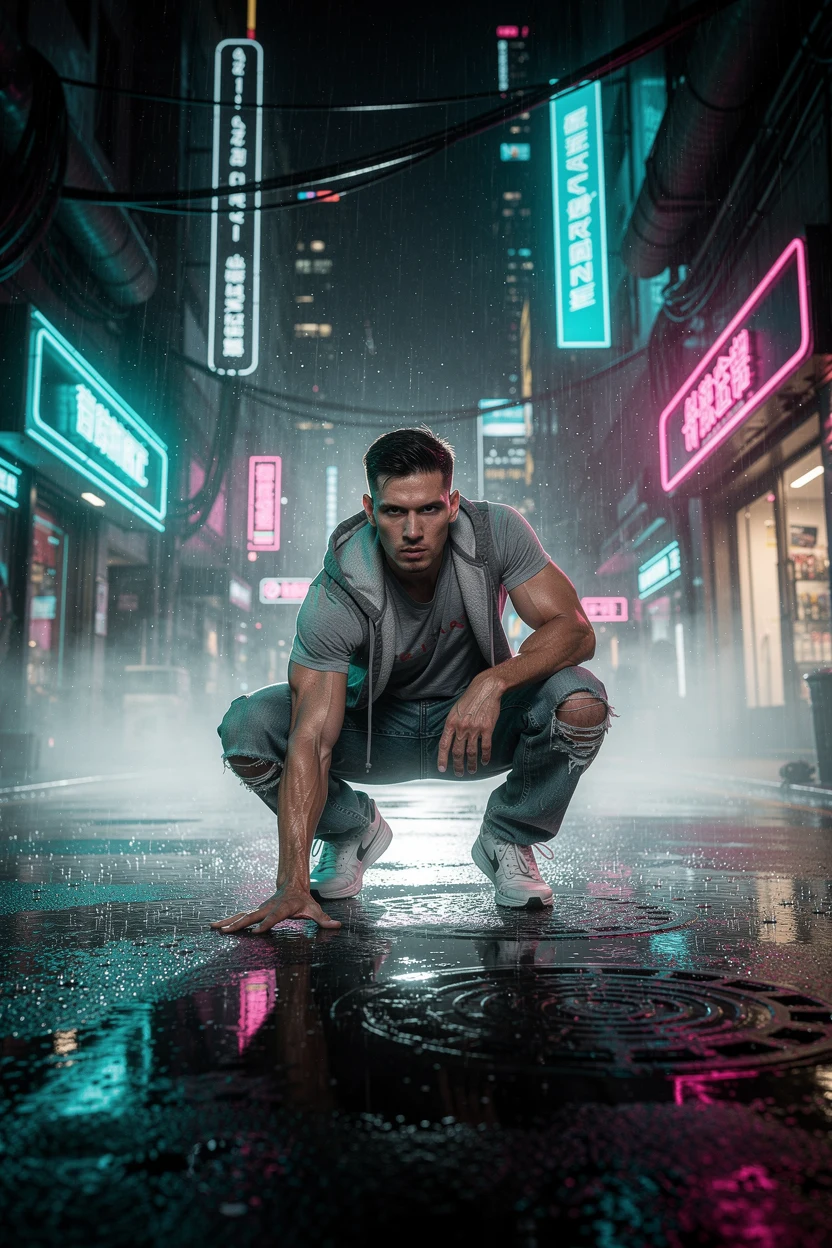
Test 08: I2V Dynamic Transformation & Depth
Setup:
Upload an image of a dancer standing in the rain.
Instruction:
The dancer suddenly performs a rapid, high-intensity breakdance power move, spinning on the ground, splashing rainwater in all directions, camera circles around the subject to show depth, cinematic lighting and reflections.
Challenge:
Extreme motion, physics simulation (water splash), camera movement, and depth perception.
| Original Image | Hailuo 2.3 (I2V) | Kling v2.6 (I2V) |
|---|---|---|
 |
Analysis:
Hailuo 2.3:
The breakdance motion looks highly artificial and does not follow realistic physics. The body movements are unnatural, and the water splash dynamics are unconvincing. The camera circling effect is weak.
Kling v2.6:
Also fails to deliver realistic motion. The spinning and ground contact look fake, and the physics of the water splash are incorrect. However, the water splash rendering itself is slightly better than Hailuo 2.3.
Scores:
- Hailuo 2.3: 1/5 (Unrealistic motion and physics)
- Kling v2.6: 1/5 (Unrealistic motion, slightly better splash rendering)
Winner: Tie (both failed)
Final Verdict
After 8 rigorous tests across diverse scenarios, Hailuo 2.3 emerges as the unexpected winner—not by a landslide, but by consistent performance in critical areas where Kling v2.6 stumbled.
Why Hailuo 2.3 Wins
1. Text rendering superiority: Hailuo 2.3 nailed the neon sign test (Test 04) with perfect accuracy, while Kling v2.6 completely failed. For workflows requiring on-screen text (marketing videos, tutorials, signage), this is a dealbreaker.
2. Physics & lighting consistency: In Test 05, Hailuo 2.3 delivered realistic torch lighting and shadow dynamics without anatomical errors.
3. Cost efficiency: At $0.28 per 5-second video vs. $0.35 for Kling v2.6, Hailuo 2.3 offers 25% cost savings—critical for high-volume production.
Where Kling v2.6 Excels
- Character consistency (Test 03): Kling v2.6's facial identity preservation during extreme expressions is industry-leading.
- Cinematic motion (Test 07): Superior photorealism and environmental detail in high-speed FPV shots.
- Native audio support: While not tested here, Kling v2.6's audio generation is a significant advantage for social media and marketing content.
The Caveat: Audio
Hailuo 2.3 does not support audio generation yet. If your workflow requires synchronized sound effects, dialogue, or ambient audio, Kling v2.6 offers native audio support (along with other models like Veo 3.1 and Sora 2). However, if you're producing silent content or plan to add audio in post-production, Hailuo 2.3 offers better cost-performance and text rendering.
Scoring Summary
| Test Scenario | Hailuo 2.3 | Kling v2.6 | Winner |
|---|---|---|---|
| 01: Fluid Dynamics | 0/5 | 0/5 | Tie |
| 02: Anatomy & Motion | 3/5 | 4/5 | Kling v2.6 |
| 03: Character Consistency | 2/5 | 5/5 | Kling v2.6 |
| 04: Text Rendering | 5/5 | 1/5 | Hailuo 2.3 |
| 05: Physics & Lighting | 5/5 | 3/5 | Hailuo 2.3 |
| 06: Multi-Subject Interaction | 3/5 | 3/5 | Tie |
| 07: Cinematic Motion | 4/5 | 5/5 | Kling v2.6 |
| 08: Dynamic Transformation | 1/5 | 1/5 | Tie |
| Total Score | 23/40 | 22/40 | Hailuo 2.3 |
Key Takeaways
- Hailuo 2.3 wins by a narrow margin (23 vs. 22 points) due to superior text rendering and cost efficiency.
- Kling v2.6 excels in character consistency, cinematic quality, and photorealistic environments (mountains, landscapes, background scenes) but fails catastrophically at text rendering.
- Both models struggle with complex fluid dynamics and extreme motion physics.
- Audio support is available in Kling v2.6 (along with other premium models)—critical for social media workflows.
Our Recommendation
- Choose Hailuo 2.3 if: You need text rendering, cost efficiency, or silent video content.
- Choose Kling v2.6 if: You need native audio, character-driven narratives, or superior photorealistic visual quality.
Test both models yourself on Vidguru to see which fits your specific workflow.
**Summary: 3 Golden Rules for Picking Your Model**
Based on our exhaustive testing at Vidguru AI Lab, follow these three rules to get the most ROI from your AI video generation:
1. The "Text & Budget" Rule: If your scene requires legible text (billboards, UI, signs) or you are running a high-volume production on a budget, Hailuo 2.3 is the superior choice.
2. The "Human Identity" Rule: If your project centers on a specific character or requires intense emotional facial expressions, do not compromise—use Kling v2.6.
3. The "Social-First" Rule: For TikTok, Reels, or any platform where sound is 50% of the experience, Kling v2.6's native audio will save you hours of editing time.
FAQ
1. Which model is better for social media content creation?
Kling v2.6 is the better choice for social media due to its native audio generation. Platforms like TikTok, Instagram Reels, and YouTube Shorts heavily favor videos with synchronized sound effects and dialogue. Kling v2.6 can generate lip-synced speech, ambient sounds, and effects in a single pass, saving hours of post-production work.
However, if you're creating silent content (text overlays, product demos, or memes), Hailuo 2.3 offers better cost efficiency and text rendering accuracy.
2. Can Hailuo 2.3 generate videos with audio?
No. As of January 2026, Hailuo 2.3 does not support audio generation. All videos are silent. MiniMax has indicated that audio support will be added in a future update, but no official timeline has been announced.
If audio is essential for your workflow, you'll need to use Kling v2.6 or add audio in post-production using tools like Adobe Premiere, DaVinci Resolve, or Vidguru's audio generation features.
3. How accurate is text rendering in AI video models?
Text rendering remains one of the hardest challenges for AI video models. In our tests:
- Hailuo 2.3 achieved perfect text accuracy (5/5) in the neon sign test, rendering "FUTURE IS NOW" with stable, legible text throughout the camera pan.
- Kling v2.6 completely failed (1/5), producing garbled, unreadable text.
For workflows requiring on-screen text (signage, subtitles, branding), while other premium models like Veo 3.1 also perform well, Hailuo 2.3 is currently the most cost-effective choice for high-quality text rendering.
4. Which model is more cost-effective for high-volume production?
Hailuo 2.3 is 25% cheaper than Kling v2.6 for 5-second videos:
- Hailuo 2.3: $0.28 per video
- Kling v2.6: $0.35 per video
For creators producing 100+ videos per month, this cost difference adds up quickly. If you're running a marketing agency, e-commerce brand, or content studio, Hailuo 2.3 offers better ROI for silent or text-heavy content.
5. Can I test both Hailuo 2.3 and Kling v2.6 on Vidguru?
Yes! Vidguru is designed specifically for side-by-side comparison. You can switch between Hailuo 2.3, Kling v2.6, and other top-tier models like Veo 3.1 within the same interface. This allows you to test the same prompt across different engines to find the perfect match for your specific creative needs.
Related Articles
- VEO 3.1 vs Kling v2.6: 2026 Benchmark Comparison for AI Video Generation
- Seedance 1.5 Pro vs Kling v2.6: Benchmark Comparison
- VEO 3.1 vs Kling v2.1 vs Sora 2: The Ultimate AI Video Generator Comparison 2025
About Vidguru
Vidguru is the all-in-one AI video & image maker for teams and creators. We unify top foundation models behind a single web app and API—go from idea to publish in minutes with production-grade reliability. One subscription replaces 10+ tools; start free with 4 daily credits.
Why Vidguru:
- All content types in one platform: videos, images, voiceovers, AI avatars, ads, and audio.
- Access to top AI models: choose the perfect model per task; switch and compare side-by-side.
- One subscription replaces dozens of tools—save monthly costs with a unified plan.
- Free trial: 4 free credits daily to explore core features.
Whether you're a content creator, marketer, filmmaker, or business owner, Vidguru provides the tools you need to bring your vision to life with AI.